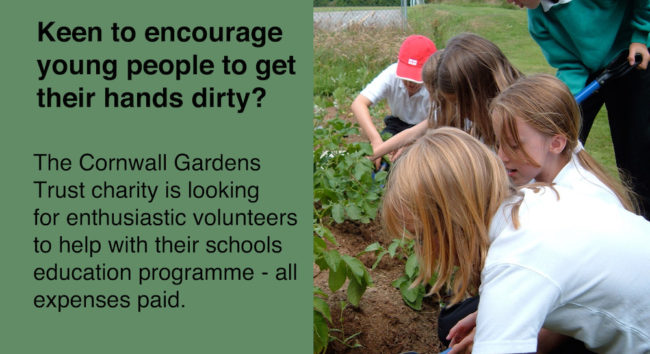
The Cornwall Gardens Trust’s Education programme has a few guiding principles. These are:
- to encourage children to become more involved in gardening and related activities;
- to provide an innovative learning environment for pupils and a useful community resource; and
- to get the children themselves to have a say about the kind of garden project they want, to help submit outline plans or designs, and to help create and maintain the garden.
The Trust assists by awarding small financial grants, and then providing volunteers who will regularly visit each school, offering advice and support on a range of garden-related activities, from plants and planting to wildlife and conservation.
Some schools have ‘challenging’ sites and few resources to spare. Both staff and children appreciate the CGT efforts made on their behalf, and it’s great to see such enthusiasm for the new garden areas.
Application forms and guidance notes are available about the grants for county primary schools, and secondary and other education establishments.
Application Guidelines for Primary Schools
Application Guidelines for Secondary Schools
To find out more, please contact our Education Coordinator via email to [email protected].
The Trust has recently put together an entertaining and informative talk about Cornwall’s garden history through the ages, from the Iron Age village at Chysauster near Penzance to present-day gardens including Eden and beyond. The talk is suitable for presentation to schools and colleges, and further details about how to go about booking this can be found by clicking here.
The following schools were awarded grants from the Cornwall Gardens Trust during the past few years:
|
School |
Project description |
| Bodmin College | Encourage students with particular needs to become involved with the school garden by growing fruit and vegetables |
| Camelford | New container fruit and vegetable garden |
| Camlann House, Camelford | Materials and tools to enable students to make better use of their exterior space while developing life skills |
| Charlestown | Landscaping of derelict land and pond, plus new orchard area |
| Coads Green | Flower beds/container planting in playground |
| Garras | Plants and tools for new pond and wildlife area |
| Grade Ruan | Raised beds/containers for playground plus help with benches and tools |
| Kehelland | Vegetable beds and flower borders |
| King Charles Falmouth | Terraced beds and planting, working with John Dyer, Eden artist in residence |
| Lanreath | Creation of garden, performance and sitting areas, and a willow structure |
| Launceston | Vegetable beds and some new planting |
| Launceston College, Castle Area Resource Base | Materials for raised beds and planters. The garden is used by special needs students and an after-school gardening club |
| Launceston College, Off Site Centre | To rescue a neglected area while encouraging students to develop transferable skills |
| Lewannick | Tools and plants for fruit and vegetable area |
| Otterham Primary School | To create an external learning environment for students so integrating the garden into the school curriculum |
| Pensilva | Raised beds/containers for Cornish plants, vegetables and small sensory garden |
| Polperro | Help with fencing for new pond and wildlife area |
| Redruth School | Encourage students to develop an understanding of sustainability and the natural environment |
| St Erth | Timber, tools and equipment for new fruit/vegetable/herb garden |
| St Francis, Falmouth | Plants and flowers for native wildflower area |
| Sir James Smith’s Community School | Set up a vegetable garden to be incorporated within the Individual Needs curriculum |
| St John’s Catholic Primary | Compost and tools to enable pupils to become actively involved in their garden |
| St Kew | Smallvegetable beds, and seating |
| St Levan | Creation of Victorian-style vegetable beds/planting |
| St Mark’s Morwenstow | Rocks for lizard area, and bird table |
| St Martin | Creation of wildlife garden, plants etc |
| St Mary’s Penzance | Tools, plants and equipment for new quiet area |
| St Michael’s Helston | Sustainable planting area by library (with help from Duchy College) |
| St Newlyn East | Help in creation of Tudor physic garden at Trerice |
| St Wenn | Clearing new garden area to be planted with native flowers and vegetables |
| Stithians | Raised beds and planting for new vegetable and flower garden |
| Tregony | Plants and equipment for sensory garden and quiet area (with some help from Duchy College) |
| Treloweth Redruth | Tools and equipment for new ‘self-funding’ allotment area at school |
| Wadebridge | Fruit trees/containers/compost/equipment for new ‘outside classroom’ (Home Farm Trust involved) |
| Wadebridge Secondary School | To develop conservation garden and create herb and vegetable beds |
| Wendron | Raised beds and screening for sensory garden |
Thanks to the generous support of the Tanner Trust we can continue our work with young people, aged 12-19, for the next few years. This will enable us to extend our work in the formal educational setting of schools and colleges, and also help young people to get a taste for horticulture in less formal educational establishments such as youth centres or community groups.
If any of you know of any schools that could benefit from our help, do please let our Education Coordinator know at [email protected]